Plus, a tortoise homecoming and a planetary parade ͏ ͏ ͏ ͏ ͏ ͏ ͏ ͏ ͏ ͏ ͏ ͏ ͏ ͏ ͏ ͏ ͏ ͏ ͏ ͏ ͏ ͏ ͏ ͏ ͏ ͏ ͏ ͏ ͏ ͏ ͏ ͏ ͏ ͏ ͏ ͏ ͏ ͏ ͏ ͏ ͏ ͏ ͏ ͏ ͏ ͏ ͏ ͏ ͏ ͏ ͏ ͏ ͏ ͏ ͏ ͏ ͏ ͏ ͏ ͏ ͏ ͏ ͏ ͏ ͏ ͏ ͏ ͏ ͏ ͏ ͏ ͏ ͏ ͏ ͏ ͏ ͏ ͏ ͏ ͏ ͏ ͏ ͏ ͏ ͏ ͏ ͏ ͏ ͏ ͏ ͏ ͏ ͏ ͏ ͏ ͏ ͏ ͏ ͏ ͏ ͏ ͏ ͏ ͏ ͏ ͏ ͏ ͏ ͏ ͏ ͏ ͏ ͏ ͏ ͏ ͏ ͏ ͏ ͏ ͏ ͏ ͏ ͏ ͏ ͏ ͏ ͏ ͏ ͏ ͏ ͏ ͏ ͏ ͏ ͏ ͏ ͏ ͏ ͏ ͏ ͏ ͏ ͏ ͏ ͏ ͏ ͏ ͏ ͏ ͏
February 27, 2026—A surprising discovery about human-Neanderthal mating, NASA delays sending humans to the moon, and AI tools to save elephants. Oh, and don't worry if you haven't achieved mastery of your craft yet. Late bloomers make the most impact on history. —Andrea Gawrylewski
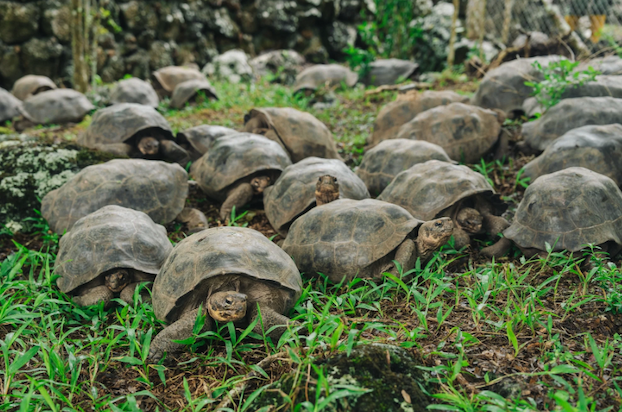
Chief Newsletter Editor | | Floreana tortoises released back onto their native island. Galápagos Conservancy | | - Around 180 years ago, Floreana Island in the Galápagos lost its unique tortoise, the Floreana giant tortoise. Last week however, scientists released 158 tortoises of Florean ancestry from a captive breeding program onto the island. | 2 min read
- NASA will not land astronauts on the moon in 2027, the space agency's administrator Jared Isaacman announced today. NASA's next lunar mission, Artemis II, has meanwhile encountered delays and problems, pushing the launch date for its flyby mission. | 2 min read
- A head-to-head trial pitting Eli Lilly's oral GLP-1 against oral semaglutide found the former resulted in greater reductions in blood sugar levels and weight, but fewer people stayed on it. | 4 min read
- A 17-year-old high schooler built an AI model that can accurately pick out gunshots from other jungle sounds, a potential breakthrough in protecting elephants from poaching. (These are the AI stories that give me hope.) | 22 min listen
- More good AI news: A new wearable AI system watches your hands through smart glasses, guiding experiments and stopping mistakes before they happen, helping novices conduct science like pros. | 4 min read
- The planets are aligning! This weekend, Mercury, Venus, Saturn and Jupiter will all be visible to the naked eye, lined up in that order stretching upward from the horizon shortly after sunset. | 2 min read
- Join the discussion: Earlier this week I wrote about proposed efforts by the FDA to make more medications available over-the-counter (sold without a prescription). This would put more responsibility on the individual to monitor their safety with medicines. What do you think of the idea? Would you feel comfortable being able to get medicines without a prescription, and why or why not? Join the discussion here.
| | Most people have some Neanderthal DNA in their genome. But for a new study, researchers compared ancient Neanderthal DNA with that of people living in Africa today who have little or no Neanderthal ancestry. The researchers found much more ancient human DNA present on Neanderthal X chromosomes, suggesting that when modern humans and Neanderthals did interbreed, tens of thousands of years ago, there was a strong sexual bias.
What this means: Male Neanderthals might have selectively mated with anatomically modern female humans and vice versa.
What the experts say: As to why these mating patterns existed, "one can only speculate!" says Sarah Tishkoff, a professor of genetics and biology at the University of Pennsylvania and a co-author on the study. The study shows the value of looking outside of human DNA to understand our own ancestry, says Alexander Platt, a senior research scientist at the University of Pennsylvania and the study's lead author.
| | An analysis of more than 34,000 world-class performers, from Olympic athletes to Nobel Prize laureates, showed that many started to shine later in life. Those who reached their peaks in youth, like varsity athletes or chess prodigies, tended to not ascend as high in their field as those who reached their peaks as adults. Plus, the researchers found that only about 10 percent of child top performers ended up becoming adult top performers. Why this is interesting: The "10,000-hour rule" is the common belief that mastery of a skill takes 10,000 hours of practiced discipline. In theory, that implies if you start early, you achieve mastery earlier. But this analysis shows that having multiple interests as a young person rather than focusing on one is correlated with becoming one of the world's best. What the experts say: For those who didn't realize their dreams early in life, this news shows your top performing days could still be ahead of you. "For people who didn't follow the prodigy route, know you are in good company!" says Purdue University psychologist Brooke Macnamara, who co-authored the analysis. "Most world-class performers didn't, either." —Emma Gometz, newsletter editor | | | | |
SPONSORED CONTENT FROM SCIENTIFIC AMERICAN TRAVEL | | 2027 Solar Eclipse on the Nile Experience the 2027 total solar eclipse—more than six minutes of totality—from the deck of a luxury Nile River ship on this incredible 10-day journey led by Chief of Reporters Clara Moskowitz. | | | | |
MOST POPULAR STORIES OF THE WEEK | | - Mathematicians make a breakthrough on 2,000-year-old problem of curves | 4 min read
- Nobel Prize–winning brain scientist steps down over Epstein ties | 2 min read
- NASA identifies astronaut Mike Fincke as triggering the unprecedented medical evacuation of the ISS | 2 min read
| | Science has many young luminaries: Subrahmanyan Chandrasekhar and his milestone theories on stellar lifecycles (developed in his 20s), Lynn Margulis and her new vision for how multicellular life evolved (first proposed in her 30s) and the 19th century Hungarian physician Ignaz Semmelweis who, in his 20s, showed that handwashing dramatically reduced maternal mortality. For each of these discoveries, confirmation and acceptance of bold ideas took time—in the case of Semmelweis, long after his death. Early bloomers in science endure the same slow progress of discovery that all science experiences—it's what makes scientific endeavor trustworthy and robust. Brilliant ideas that take a long time to find wider acceptance are sometimes called Sleeping Beauties. Read about some of the biggest ones here. | | Thanks for reading Today in Science this week. Send any thoughts, observations, or your favorite sleeper scientific discovery to: newsletters@sciam.com. See you on Monday. —Andrea Gawrylewski, Chief Newsletter Editor
| | | | |
Subscribe to this and all of our newsletters here. | | | | |





Comments
Post a Comment