They're often called the "Nobel Prizes of math" ͏ ͏ ͏ ͏ ͏ ͏ ͏ ͏ ͏ ͏ ͏ ͏ ͏ ͏ ͏ ͏ ͏ ͏ ͏ ͏ ͏ ͏ ͏ ͏ ͏ ͏ ͏ ͏ ͏ ͏ ͏ ͏ ͏ ͏ ͏ ͏ ͏ ͏ ͏ ͏ ͏ ͏ ͏ ͏ ͏ ͏ ͏ ͏ ͏ ͏ ͏ ͏ ͏ ͏ ͏ ͏ ͏ ͏ ͏ ͏ ͏ ͏ ͏ ͏ ͏ ͏ ͏ ͏ ͏ ͏ ͏ ͏ ͏ ͏ ͏ ͏ ͏ ͏ ͏ ͏ ͏ ͏ ͏ ͏ ͏ ͏ ͏ ͏ ͏ ͏ ͏ ͏ ͏ ͏ ͏ ͏ ͏ ͏ ͏ ͏ ͏ ͏ ͏ ͏ ͏ ͏ ͏ ͏ ͏ ͏ ͏ ͏ ͏ ͏ ͏ ͏ ͏ ͏ ͏ ͏ ͏ ͏ ͏ ͏ ͏ ͏ ͏ ͏ ͏ ͏ ͏ ͏ ͏ ͏ ͏ ͏ ͏ ͏ ͏ ͏ ͏ ͏ ͏ ͏ ͏ ͏ ͏ ͏ ͏ ͏
July 23, 2026—Mammograms can catch heart disease and the Fields Medal winners are announced. Plus, what is the most efficient animal in motion?
—Andrea Gawrylewski
Chief Newsletter Editor
|
|
Hieroglyphs from the Temple of Kom Ombo in Egypt. Stuart Dee/Getty Images
|
|
During a lost "golden age" of language, humans may have spoken tens of thousands of different tongues, a new study suggests. | 3 min read
The 2026 Fields Medals, often called the "Nobel Prizes of math," were awarded this morning to four young mathematicians for their breakthrough work on the math of messy fluids, tangled knots, spinning pencils and more. | 6 min read
Environmental groups are suing the U.S. government over a proposed land deal with SpaceX. If approved, the deal would grant SpaceX hundreds of acres in a wildlife refuge in South Texas in exchange for slightly smaller area of nearby private land. | 2 min read
We sat down with actor Tom Hiddleston to talk about his lifelong fascination with the ancient world. He is the host of a new docuseries that began this week called Pompeii: Out of Time. | 6 min video
Within days of Moonshot AI releasing its AI model Kimi K3, user demand overwhelmed the company's computing power. Opensource models like Kimi K3 could transform the field. | 4 min read
Video footage shows orcas ramming and smashing fish. The behavior could be a strategy to help younger orcas feed, or it may just be for their own amusement, researchers say. | 2 min read
|
|
Animal Locomotion
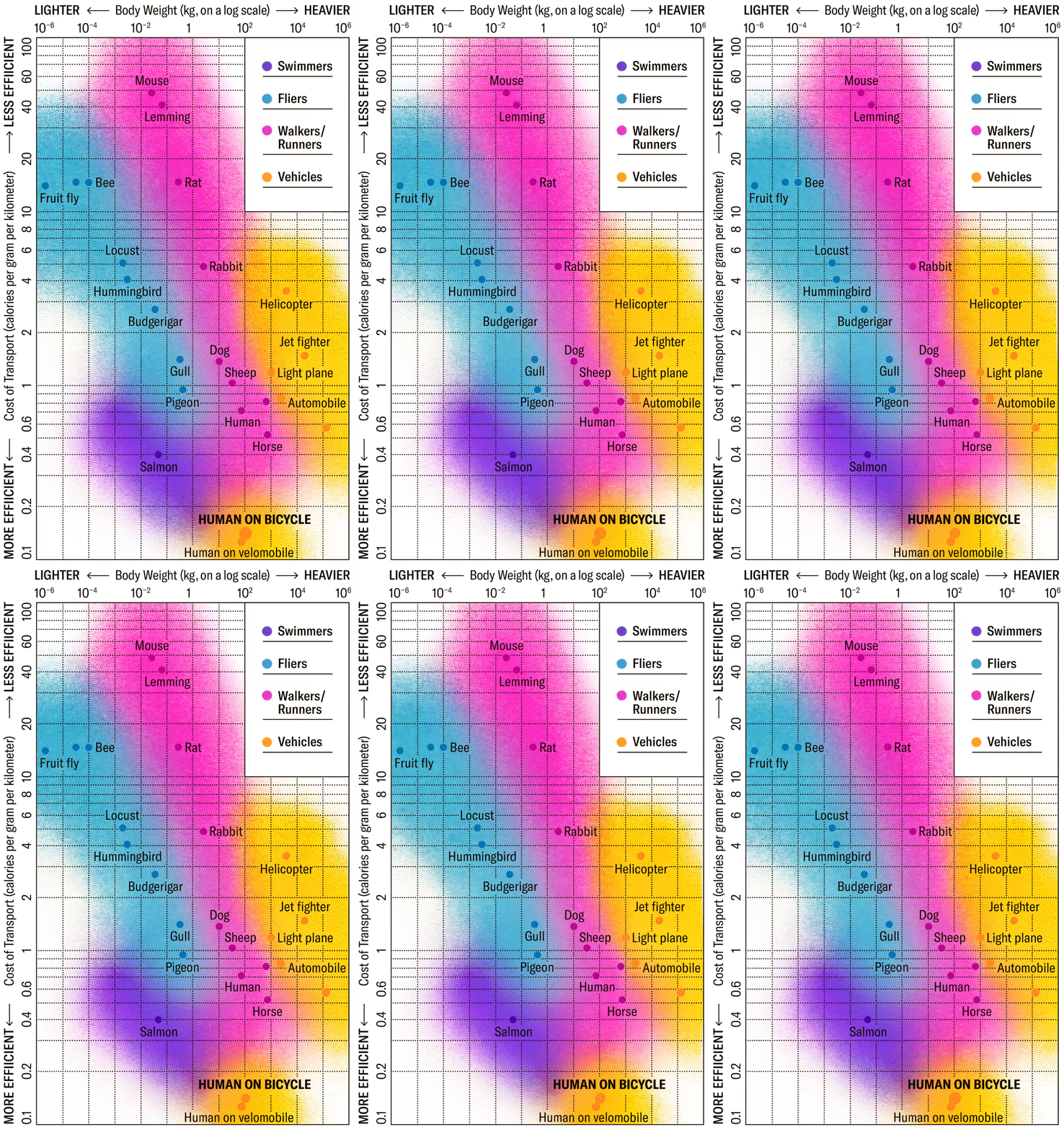
Travel involves two main expenditures of energy: fighting gravity and propelling yourself forward. Most terrestrial animals must expend energy first to stand up, then to take each step forward. Flying animals, though, can move forward cheaply by gliding through the air, carried more by currents than by their own power. Swimming animals can similarly glide through water while letting their natural buoyancy minimize the need to fight gravity. Taking this all into account, humans don’t rank as very efficient travelers. Unless, that is, you put us on a bicycle.
How it works: Bikes allow us terrestrial folk to be more like fish. Wheels and bearings roll with low friction, letting us coast without putting in power by pedaling, and the rigid frame supports the sitting rider against gravity. The main drawback is our clunky human shape; bicyclists aren’t streamlined like a bluefin tuna, so they must overcome more drag. Bicycles with an aerodynamic shell, called velomobiles, let humans move with even more aquatic efficiency.
The rankings: In honor of our 180th anniversary last year, we remade a classic graphic from 1973 comparing the efficiency of animals' locomotion. Humans on bikes (or velomobiles) outrank salmon and horses by a fair margin.
|
|
DTAN Studio; Sources: “Energetic Cost of Locomotion in Animals,” by Vance A. Tucker, in Comparative Biochemistry and Physiology, Vol. 34; June 15, 1970 (most data); chart by Dan Todd in “Bicycle Technology,” by S. S. Wilson, in Scientific American, Vol. 228, No. 3; March 1973 (data for human on a bicycle); Tyson Hedrick/University of North Carolina at Chapel Hill (velomobile calculation)
|
|
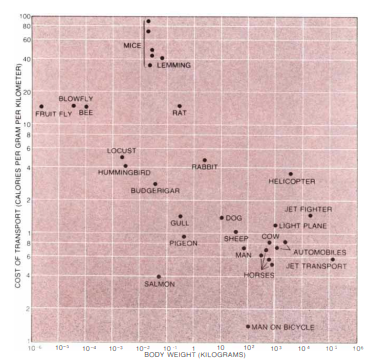 Scientific American By the way, here's the original graphic titled "Man on a Bicycle" from our March 1973 issue. I like the newer version better, don't you? Scientific American By the way, here's the original graphic titled "Man on a Bicycle" from our March 1973 issue. I like the newer version better, don't you? |
|
|
|
Catching Heart Disease
Mammograms save thousands of lives every year by detecting signs of breast cancer early, but new research shows they can catch heart disease early, too. Researchers developed an AI model that scans mammograms to quantify bright streaks of calcium buildup, a marker of stiffened breast artery tissues. The severity of these so-called breast arterial calcifications (BAC) can help predict associated heart disease risk.
How it works: The researchers behind this technology saw in surveys of more than 100,000 people that even small increases in BAC correlated with slightly raised cardiovascular risk, and severe levels of BAC were associated with fourfold to eightfold increases in events such as heart attack and stroke compared with rates in those who have none. They then developed an AI model that scans for BAC from mammograms without any additional work from the radiologist. Although there are other BAC detection tools, the new model offers the first way to measure and track the amount of BAC and tie that amount to higher disease risk.
What the experts say: The new model could also help take “the burden off the radiologist” to spot BAC and choose to evaluate and report risk, adds radiologist Laurie Margolies, who specializes in breast imaging at Mount Sinai in New York City and was not involved in the study. —Emma Gometz, Newsletter Editor
|
|
|
|
|
|
TRAVEL WITH SCIENTIFIC AMERICAN
|
|
Experience Yellowstone as a Winter Wonderland
Reservations now open! This January, journey deep into Yellowstone National Park with your guide, Senior Desk Editor Andrea Thompson, for a spectacular week-long exploration of snowy landscapes, steaming geysers and roaming wildlife.
|
|
|
|
|
|
YOUNG AMERICAN SCIENTISTS
|
|
Comparative biologist Armita Manafzadeh, soon to set up her own lab at the Georgia Institute of Technology, studies the evolution and development of joints. She uses CT scans of animals’ bones paired with high-speed video of the animal moving—say, an alligator walking on a treadmill—to build “4D x-ray vision” animations. The resulting scans show how the animals’ skeletons move inside their bodies and can be used to reconstruct the gaits of extinct species. "From a young age, I found anatomy and morphology really, really interesting," she says. "That inherent interest has stayed with me my whole life."
Read all the Young American Scientists profiles here.
|
|
This newsletter is powered by caffeine, existential curiosity and subscribers to Scientific American. Join us: 90 days for just $1.
|
|
I have vivid memories of visiting Pompeii on a family vacation many years ago. It's been nearly 2,000 years since ash and pumice from a catastrophic eruption of Mount Vesuvius blanketed the city and killed the residents who could not evacuate. Though their remains are gray, lifeless and frozen in time, the victims of Pompeii still evoked, at least for me, a striking set of emotions. Have you ever been? Let me know what you thought (and if you catch the docuseries, tell me how you liked it).
|
|
Please send any other cool ideas, comments or feedback on this newsletter to: newsletters@sciam.com. See you tomorrow!
—Andrea Gawrylewski,
Chief Newsletter Editor
|
|
|
|
|
Subscribe to this and all of our newsletters here.
|
|
Scientific American
1000 N West Street, Suite 1200
|
|
|
|
|







Comments
Post a Comment