The Math of Time Travel
We all have some past events we’d like to undo. These can be minor moments, such as a failed exam or an argument with friends, or world-changing incidents, such as the 2019 outbreak that led to the COVID pandemic.
Outside of science-fiction stories we have yet to encounter time travelers. But various scientific disciplines, from physics and mathematics to philosophy, have been exploring the topic for decades.
The basis for most potential time travel ideas lies in Albert Einstein’s special and general theories of relativity, which he published in 1905 and 1915, respectively. With these theories, he turned our understanding of the world upside down. According to Einstein, time and space are not static quantities but can be stretched or compressed depending on the situation. In other words, a steel rod is not the same length everywhere and at all times, and a second can sometimes pass very quickly and sometimes very slowly.
The latter may sound familiar—an hour of school or work can drag on, while an hour with friends flies by. But Einstein wasn’t concerned with the perception of time; he was talking about its actual duration. For example, according to relativity, a second on the Earth’s surface differs from a second on a satellite orbiting it.
Travel into the Future thanks to Rapid Movement
Einstein’s special theory of relativity makes time travel possible—but only into the future. As the physicist discovered, clocks run slower for moving observers. So if you board a spaceship for a five-year-long round trip through space, and the craft travels at 97 percent of the speed of light, a good 20 years will have passed on Earth when you return. That’s why, after 11 months on the International Space Station, NASA astronaut Scott Kelly is now an additional 13 milliseconds younger than his twin, who remained on Earth.
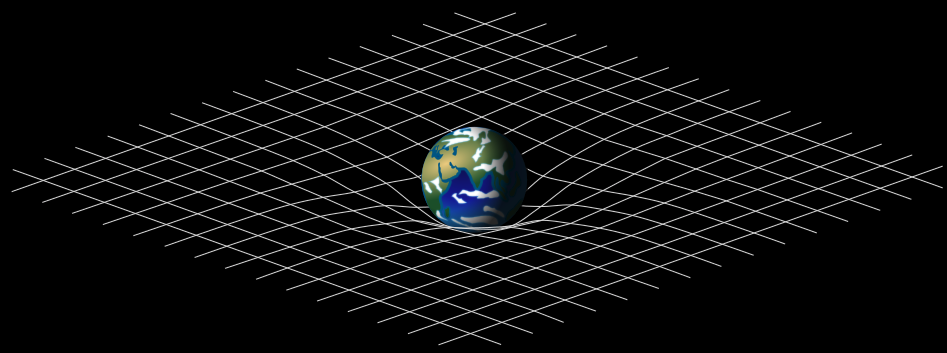
It’s not only motion that can make time pass more slowly or quickly, however; gravity or acceleration can also do so. This is because of Einstein’s insight that gravity is a geometric effect: mass and energy (which are equivalent, according to E = mc²) curve spacetime, which in turn controls the direction of motion of massive objects. You can imagine that heavy objects such as stars leave a depression in spacetime, which is why other massive objects such as planets are attracted to them.





Comments
Post a Comment