Plus, the latest on Artemis II ͏ ͏ ͏ ͏ ͏ ͏ ͏ ͏ ͏ ͏ ͏ ͏ ͏ ͏ ͏ ͏ ͏ ͏ ͏ ͏ ͏ ͏ ͏ ͏ ͏ ͏ ͏ ͏ ͏ ͏ ͏ ͏ ͏ ͏ ͏ ͏ ͏ ͏ ͏ ͏ ͏ ͏ ͏ ͏ ͏ ͏ ͏ ͏ ͏ ͏ ͏ ͏ ͏ ͏ ͏ ͏ ͏ ͏ ͏ ͏ ͏ ͏ ͏ ͏ ͏ ͏ ͏ ͏ ͏ ͏ ͏ ͏ ͏ ͏ ͏ ͏ ͏ ͏ ͏ ͏ ͏ ͏ ͏ ͏ ͏ ͏ ͏ ͏ ͏ ͏ ͏ ͏ ͏ ͏ ͏ ͏ ͏ ͏ ͏ ͏ ͏ ͏ ͏ ͏ ͏ ͏ ͏ ͏ ͏ ͏ ͏ ͏ ͏ ͏ ͏ ͏ ͏ ͏ ͏ ͏ ͏ ͏ ͏ ͏ ͏ ͏ ͏ ͏ ͏ ͏ ͏ ͏ ͏ ͏ ͏ ͏ ͏ ͏ ͏ ͏ ͏ ͏ ͏ ͏ ͏ ͏ ͏ ͏ ͏ ͏
April 3, 2026—Western snowpack is in dire straits. Plus, the first-ever view of a deep-sea coral reef. And we check in with Artemis II. —Andrea Gawrylewski
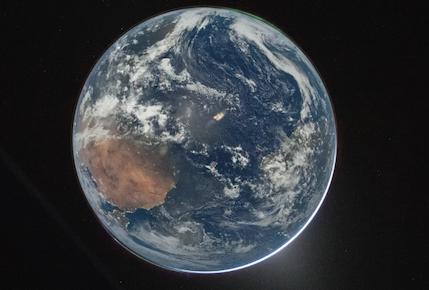
Chief Newsletter Editor | | Artemis II Commander Reid Wiseman took this picture of Earth from the Orion spacecraft's window after completing the translunar injection burn. There are two auroras (top right and bottom left) and zodiacal light (bottom right) is visible as the Earth eclipses the Sun. NASA/Reid Wiseman | | - The Artemis II mission, as of 10 a.m. EDT this morning, was about 88,000 miles from Earth and 170,000 miles away from the moon and traveling around 4,260 miles per hour. | 2 min read
- Last night, the crew ignited the spacecraft's main engine and completed a "translunar injection burn" which nudged the craft onto the correct path to reach the moon. | 2 min read
- Roughly 13 hours into his journey to the moon, Mission Commander Reid Wiseman ran into a problem: he had "two Microsoft Outlooks" and neither worked. Listen on Instagram. And don't miss the funny comments.
- The Artemis II AVATAR experiment will carry "organs on a chip" to the moon and back, revealing how such a journey affects the body's cells. | 3 min read
- The Artemis II astronauts may be able to get a good view of the comet MAPS while they are on the far side of the moon. | 3 min read
Coming up:
This weekend, the crew of the Orion will be getting ready to gather data and take photographs and video when they reach the moon, testing their flightsuits, and taking pictures of celestial objects out the spacecraft windows. On Sunday their spacecraft will enter the lunar sphere of influence, the point at which the pull of the moon's gravity will become stronger than the pull of Earth's gravity. Follow all our coverage throughout the weekend. | | - A treasure trove of fossils discovered in China may rewrite the timeline of the evolution of complex animal species. | 3 min read
- The Department of Health and Human Services and the Environmental Protection Agency announced a joint effort to track microplastics in drinking water—but experts say doing so will be difficult. | 4 min read
- After multiple efforts to rescue a stranded humpback whale in the Baltic Sea off the coast of Germany to no avail, experts have decided to halt all rescue efforts. The whale was entangled for weeks in fishing nets and likely got lost. | 7 min read
- Where did the OMG particle, the highest energy cosmic ray ever detected, come from? | 5 min read
- A Los Angeles jury found Instagram and YouTube negligent in how they were built, opening a new legal fight over how courts view social media. But will it affect your algorithm? | 5 min read
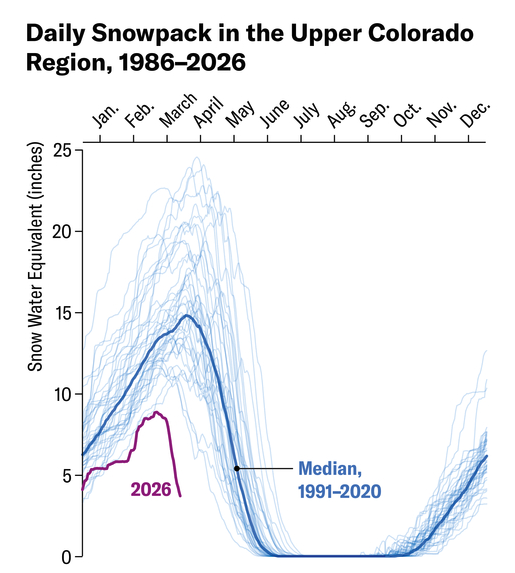
| | Snowpack on the mountains of the western U.S. is usually at peak levels this time of year. But this year it's dismally low compared with past seasons. Mild weather made it the warmest winter on record for nine western states, so most precipitation fell as rain, not snow. Other areas saw below average precipitation. Then a record-shattering heat wave hit in March, causing a massive melt of what little snow there was.
Why this matters: The snowpack typically serves as the West's water reserve, enabling rivers and reservoirs to stay topped up as it slowly melts during the spring and summer. Without the snow, the threat rises for water shortages and wildfires. The Colorado River Basin is in particular trouble. Snowpack there has been at or near record lows all winter, by a wide margin. The chance of water shortages will be high this summer along the struggling Colorado River (which is already suffering a severe and multidecade drought).
What the experts say: "These numbers are highly alarming," said climate scientist Daniel Swain on his YouTube channel on March 23, during the heat wave's height. "The March snowpack is doing something that it really hasn't done before on a widespread basis, to my knowledge, ever in recorded history, which is plummet."
| | Amanda Montañez; Source: National Water and Climate Center, Natural Resources Conservation Service, U.S. Department of Agriculture (data) | | | | |
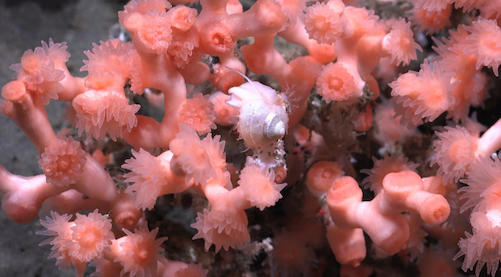
Small animals take shelter in lush coral colonies. ROV SuBastian/Schmidt Ocean Institute (CC BY-NC-SA) | | Researchers have finally laid eyes on a deep sea coral colony on the ocean floor off the coast of Argentina. One location, called Mar Del Plata Submarine Canyon, is estimated to be more than 3,500 meters deep and as large as South Africa. Deep-sea coral colonies live in complete darkness and filter feed on the detritus that falls from the surface of the ocean. But even though they thrive in the darkness, they can be brightly colored. See more pictures here. | | MOST POPULAR STORIES OF THE WEEK | | - How to build self-control, according to psychologists | 5 min read
- New 'Cicada' COVID variant is spreading in the U.S.—here's what to know | 2 min read
- Artemis II's toilet is a moon mission milestone | 4 min read
- Artemis II's journey to the moon, day by day | 2 min read
| | We'll be keeping close track of Artemis II this weekend and gearing up to tell you about some important milestones for the mission on Monday. Follow along all of our moon mission coverage here. It's a thrilling time for scientific discovery! | | Thanks for reading Today in Science this week. I always love hearing from you, so keep sending your thoughts, questions or feedback on this newsletter to: newsletters@sciam.com. —Andrea Gawrylewski, Chief Newsletter Editor
| | | | |
Subscribe to this and all of our newsletters here. | | | | |




Comments
Post a Comment