A newsletter for unflinching, ever-curious science-lovers. ͏ ͏ ͏ ͏ ͏ ͏ ͏ ͏ ͏ ͏ ͏ ͏ ͏ ͏ ͏ ͏ ͏ ͏ ͏ ͏ ͏ ͏ ͏ ͏ ͏ ͏ ͏ ͏ ͏ ͏ ͏ ͏ ͏ ͏ ͏ ͏ ͏ ͏ ͏ ͏ ͏ ͏ ͏ ͏ ͏ ͏ ͏ ͏ ͏ ͏ ͏ ͏ ͏ ͏ ͏ ͏ ͏ ͏ ͏ ͏ ͏ ͏ ͏ ͏ ͏ ͏ ͏ ͏ ͏ ͏ ͏ ͏ ͏ ͏ ͏ ͏ ͏ ͏ ͏ ͏ ͏ ͏ ͏ ͏ ͏ ͏ ͏ ͏ ͏ ͏ ͏ ͏ ͏ ͏ ͏ ͏ ͏ ͏ ͏ ͏ ͏ ͏ ͏ ͏ ͏ ͏ ͏ ͏ ͏ ͏ ͏ ͏ ͏ ͏ ͏ ͏ ͏ ͏ ͏ ͏ ͏ ͏ ͏ ͏ ͏ ͏ ͏ ͏ ͏ ͏ ͏ ͏ ͏ ͏ ͏ ͏ ͏ ͏ ͏ ͏ ͏ ͏ ͏ ͏ ͏ ͏ ͏ ͏ ͏ ͏
January 9, 2026—A longevity superpower in sharks, eavesdropping dogs and a look ahead at 2026's most noteworthy celestial events. —Robin Lloyd, Contributing Editor | | A gleaming Jupiter at opposition (to the sun), rare occultations of the bright star Regulus by the moon, and an opportunity to see the distant planet Uranus are among the U.S.-based skywatching highlights of 2026, writes astronomer and Scientific American columnist Phil Plait. Other key moments include a total lunar eclipse in early March, the moon passing in May less than three degrees from Venus, and Venus and Jupiter appearing just 1.5 degrees apart in the sky on June 9. You're probably anticipating the August 12 total solar eclipse too (see travel ad below), casting a shadow path from Greenland to Spain. It can't be seen in the U.S., but a partial solar eclipse will be visible in Maine. Why this is cool: Many of these events are unique or obscure, unlike the clock-like appearances of constellations and meteor showers. Many relate to our moon and the other planets, which "move with the cogs of different celestial gears," writes Plait. What experts say: For a more complete and global calendar, Plait recommends obtaining details for events visible in your location at In-The-Sky.org. | | Underground fiber-optic cables that carry Internet traffic are so sensitive that they can be used to detect and track earthquakes in better detail than seismographs can, a new study shows. Tiny ground vibrations and changes in pressure and temperature can affect the flow of light through these cables. In the recently published experiment, 15 kilometers of telecom fiber near Mendocino, Calif., recorded a magnitude 7 rupture, the region's biggest quake in five years. The data allowed researchers to track the initiation and progression of tremors to an unprecedented degree of detail.
Why this matters: The case study demonstrates that the nation's fiber-optic cables could be put to use to improve earthquake early-warning systems. The approach could prove especially helpful for coastal communities vulnerable to offshore quakes and tsunamis, reports freelance science journalist Saugat Bolakhe. What experts say: Telecom providers typically try to reduce environmental interference on fiber-optic cables because even a small touch or bend can disrupt the flow of data. But scientists are happy to turn lemons into lemonade. "What's noise to telecommunications is data to us," says Zhongwen Zhan, a geophysicist at the California Institute of Technology. —Emma Gometz, newsletter editor | | | | |
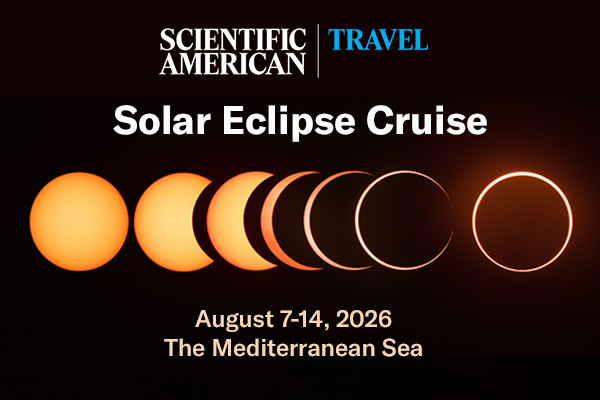
Limited Space Available for 2026 Mediterranean Eclipse Cruise | | Join us! We secured additional cabins for our 2026 solar eclipse cruise. Reserve yours now for the experience of a lifetime: watching totality approach while surrounded by the sea, fellow science lovers and your trip leader, Senior Editor Clara Moskowitz. | | | | |
- Do you know the answer to the first question of today's science quiz? Also, don't miss today's Spellements. If you spot any science words missing from Spellements, email them to games@sciam.com. In recent days, reader Kenneth G found codicil and boffin, and Paul B, Howard M and Mitch C found guanaco. We're a little embarrassed that we'd failed to include gluon, as six players noted.
| | MOST POPULAR STORIES OF THE WEEK | | - Hundreds of Iceberg Earthquakes Rattle Antarctica's Doomsday Glacier | 4 min read
- Wegovy Weight-Loss Pills Are Now Available in the U.S.—Here's What That Means | 3 min read
- Earliest Human Ancestor May Have Walked on Two Legs | 3 min read
- RFK, Jr., Upsets Food Pyramid, Urging Americans to Eat More Meat | 5 min read
| | Never before has NASA rushed astronauts home from a space mission, but the agency now plans to do so "within the coming days," reports Scientific American's Meghan Bartels. A "serious medical condition" apparently arose quickly Wednesday among one of the four Crew-11 astronauts, who arrived at the International Space Station on August 1, 2025. The Crew-11 astronauts are Zena Cardman, 38, Michael Fincke, 58, Oleg Platonov, 38, and Kimiya Yui, 55. The astronaut with the health concern currently is stable, per NASA. The individual's name is being withheld for privacy reasons. I hope they receive specialized care back on Earth, as soon as possible. | | —Robin Lloyd, Contributing Editor
| | | | |
Subscribe to this and all of our newsletters here. | | | | |







Comments
Post a Comment